blank'/> Streaming Du Jour : horror

fwwtv

fwwtv
Showing posts with label horror. Show all posts

Friday, June 5, 2015

"Tusk" (2014) on Amazon Prime

"You don't say Hitler in an airport."


     I've been thinking about 1994 lately. It was watching Brett Morgen's Kurt Cobain documentary,  "Montage of Heck", that cast my thoughts back to that year. I was 14 and 14 is the perfect age for a rock star death to hit you like a ton of brick's. When you're 14 everything means more and that goes for music and movies, too. When you're 14 those things become a part of you and help define the person you are struggling to become. I can't really listen to those Nirvana record's much anymore, or watch film's like "Pulp Fiction" or "Clerks" because they so strongly elicit overwhelming melancholic nostalgia. They take me back to exactly who I was then.


     The sadness of Cobain for me is a selfish one. We weren't able to age forward in time together- he's forever there in 1994. What I'm saying isn't new or profound, it describes the basic human experience of loss, but at 14 I (fortunately) hadn't experienced any of that. His suicide was the first time death had taken away something I cared about. This is all a very roundabout way of saying "Montage of Heck" is a profoundly affecting, disarmingly intimate film. One that makes it possible to time travel back to the late 80's and early 90's to spend time with Cobain and allows us access to the human, non rock star moments of his private life. A byproduct of the film was that it made me really grateful for the artist's I loved at that age who are still around. A loyal bond is created with the artist's you love as a teenager, those allies who help you escape the boredom of your room and the cruel, awkward school week. I love being able to anticipate a new Tarantino film at 35 year's of age, and, thanks to Smodcast, my life is more filled than ever with Kevin Smith. I think my 14 year old self would've been glad these guys still mean something to adult me, that the stuff I liked then still matters two decades later.

     If Cobain is frustrating because he wasn't able to grow older with us, then Smith is the opposite- a source of joy because he's still a big part of my pop culture landscape. But, while Tarantino is making the exact type of film's you could have predicted he would be making, no one could've anticipated a Kevin Smith who makes Fred Phelps and walrus suit horror films. A creative force who tried to give people what he thought they wanted and got kicked for his efforts, Smith in 2015 is a guy who makes the film's he wants to see and gets kicked for them instead. A certain kind of internet cinephile has a strange venomous vitriol for Smith. He's been singled out as the guy it's cool to dislike and you can hear the snarks salivating each time he makes a new film. But, that's OK. Smith is no longer creating offerings aimed for mass acceptance, he's creating works to make himself happy and that's ideally what an artist should do.

     My appreciation of Smith's work isn't based on blind nostalgic loyalty, though. I genuinely think he's done a lot of good work post "Dogma", but I wasn't always so on board. He lost me with "Jay and Silent Bob Strike Back". With that film I saw a vibrant, exciting indie filmmaker disappear into a vortex of self referential fan service. I was 21 and it seemed like the time had come for me to exit Smith's world. It felt like he had ceased making film's which spoke to me. Until five years later he did. With "Clerks II" Smith used the character's from the first film as Garden State Antoine Doinel's to comment on life in one's 30's in a way that resonated more profoundly than any film with a donkey show has a right to. I was back on board. And, with the exception of the work for hire "Cop Out", I've been a fan of Smith's work since. "Zack and Miri" is a sweet love letter to film making and "Red State", the film where he reasserted himself as an indie writer/director, may be his finest work.


     And now, there's "Tusk". To get to "Tusk", we have to get to Smodcast, Smith's long running podcast with producer and friend Scott Mosier. Launched in early 2007, Smodcast started to become the show we know today when Smith began smoking weed in earnest following the box office failure of "Zack and Miri". Smodcast is a rambling free form conversation between two old friends and is often the vehicle for hilariously surreal and filthy improvised storytelling. Whether it's Gordo, Mosier's angry Canuck character, or true life tales such as the "Gimli Glider", Canada has been a favorite topic of the show, proving fertile creative ground for the host's imaginations and the setting for Smith's "True North" trilogy of which this is the first entry. The ability to bring stories to life on a weekly basis using just a microphone and his brain has reinvigorated Smith, who just a few short year's ago announced he was done as a filmmaker. Based on an episode of Smodcast entitled "The Walrus and The Carpenter", "Tusk" represents the moment when Smith the podcaster and Smith the director become one.

     Wallace Bryton (Justin Long) is a shock jock on the hit podcast "The Not See Party" which he co-hosts with Teddy Craft (Haley Joel Osment). When Bryton's trip to Manitoba to interview viral sensation "The Kill Bill Kid" (the "Star Wars Kid" except with more limb severing) falls through due to unforeseen circumstances, he's stuck with trying to find some kind of content for his show while in Canada. In the bathroom of a bar he comes across a strange, rambling ad placed by Howard Howe (Michael Parks) seeking a living companion. Thinking he has found a great subject for his show, Bryton calls upon Howe.


     But, what begins as a charming discussion over tea with a charismatic raconteur, soon becomes a psychotic descent into horror when Howe reveals the true reason for his ad. An ascoted, bespectacled, wheelchair bound lion, Parks' delivery of Smith's dialogue is hypnotic. He relates to Bryton his happiest memory, of a time he was marooned after a shipwreck with only a walrus he called "Mr. Tusk" as a companion. It is his intention that Bryton will become his new Mr. Tusk. Boorish and shticky, Long is perfect as Bryton, an unapologetic careerist who has sold out his decency for fame, money and pussy. And Parks, an unhealthy twinkle forever in his eye, is absolutely terrifying in his portrayal of madness unhinged. One of the most unique presences in screen history, he's been given the roles of a lifetime by Smith, who's done more with the actor's gift's than even the great necromancer of career's, Tarantino, has been able to do.


     From "Clerks" to "Smodcast" conversation has been Smith's stock in trade (even his speaking event's have taken the form of a Q&A dialogue with the audience). With "Tusk" conversation reaches it's nightmarish endpoint. Bryton, who makes his living through dialogue, is physically disfigured so that he is unable to emit any noise other than a terrible bark. Park's character's in his two film's with Smith have been evil monologists.


     Johnny Depp shows up late in the film and I imagine that's where it loses many people. He plays Guy Lapointe, Van Helsing (by way of Jacques Clouseau) to Howe's Dracula. Sporting some sort of psuedo Quebecois accent, along with his usual array of tic's, Depp made me realize how enjoyable he is in small doses. All the acting choices that usually make him so aggravating are actually funny here and he disappears into his character in a manner almost worthy of Peter Sellers. The overwhelming silliness of Depp's scenes stands in jarring contrast to the dark, disturbing tone established until that point. Strangest of all is a flashback with Parks and Depp that is nothing less than a face off of bizarre affectations between two generation's of weirdo thespians. It's a scene you're not going to see in any other film by any other filmmaker and that is the greatness of "Tusk".


     Smith is making the kind of offbeat non mainstream picture's we need. He's pursuing the wildest ideas of his career and I find it absolutely exhilarating. He has mentioned on Smodcast that at this point he's being inspired by film's like "Re-Animator" and "From Beyond", and "Tusk" hits with an originality and audacity akin to film's from the era where guy's like Stuart Gordon and Frank Hennenlotter were proving that just because something is in poor taste doesn't mean it has to be dumb. I don't know why the genre film community hasn't championed "Tusk". It's the kind of film we get all too seldom- a unique vision of grotesque imagination. In a current horror scene that spends much of it's time trying to evoke the past, it's refreshing to get a film beholden to nothing except it's creator's sick whim's. Upsetting, funny, confounding- "Tusk" is everything fringe cinema should be, and proof that in 2015 Kevin Smith the indie auteur is alive and kicking.


Friday, May 29, 2015

"The Phantom From 10,000 Leagues" (1956) on Hulu Plus and Youtube

"Why the gloom? Dad's just been acquitted of murder."


     The Milner Brothers tell you this movie is cut rate right from jump street. It's there in the title: "The Phantom From 10,000 Leagues", it lets you know you are getting fifty percent of the leagues Disney gave you two year's earlier. The title is a bit misleading, though. The titular "phantom" is barely in the picture. Despite the fact that the movie starts right off with the creature attacking (well, it's more like pawing) a fisherman in a rowboat, what the film is mainly concerned with is people talking endlessly, usually on the beach in suit's.

   
     The "phantom" creature is an impossibly goofy looking thing, a near immobile "Creature From the Black Lagoon" knock-off with a macrocephalic dragon head. When the dead fisherman's body washes ashore, it's found by the only two people on the desolate stretch of beach: William Grant (Rodney Bell), a government agent, and "Ted Baxter" (Kent Taylor), who introduces himself as a "tourist and beach comber", but is really Dr. Stevens, a world renowned oceanographer, who has studied the effects of radioactivity on marine life. The production clearly had access to a small stretch of beach to film on, and it's the stage for much of the film. There's a completely unintentional bleak poetry to many of the beach scenes, looking something like the California schlock version of a Bergman film.


     Watching the two men from a hiding spot is George Thomas (Phillip Pine), a shady character who in his first scene is as he is in almost all his scenes: holding a spear gun. Seriously, he is almost never without one. George is after the atomic secrets of the mysterious Professor King (Michael Whalen). He's the true villain of the piece. It should've been titled, "The Guy Named George From the Beach", but I guess that doesn't really put asses in the seats. The nefarious interests George works for are represented by a blond named Wanda (Helene Stanton). In an odd but kind of cool move that may be artistic, but is more than likely lazy, she just sits under a parasol on the beach for almost the entirety of her screen time.


     Prof. King looks like a doughy, rumpled version of Robert Ryan and delivers wonderfully hammy overwrought dialogue, as when he addresses his secretary, "Ethel, I consider you an intelligent woman. A bit bitter, perhaps. No great lover of mankind, but still intelligent..." His laboratory emits really neat electronic sounds and it's here he irradiates a turtle and I think turns it into the phantom. I think. I'm not really sure. The movie is kind of unclear on that. It's kind of unclear on a lot of things.


     Milner shows a bit of noirish panache when he uses Ethel's (Vivi Janiss) shadow to give away that she is eavesdropping on King and Stevens. Now, I'm not saying the guy is an expressionist wunderkind, just that it demonstrates at least some degree of creative ingenuity when it comes to the visuals and I wanted to give some kind of prop's to this movie I'm not being very nice to. Milner even manages to slip a little cheesecake into the mix when Dr. Stevens stops by the Professor's place at the very same time his daughter, Lois (Cathy Downs), is taking a shower.


      Taylor is a classic fifties B cinema leading man- great hair, some clothes I'd kill for and a bit too old for his love interest. During a long rambling scene he tells the Professor he knows "There's a shaft of light coming up out of the ocean, I have reason to believe it's nuclear in character...", he's seen the monster guarding it firsthand and fears the light could be weaponized. I watched the scene twice in an attempt to decipher it's nonsensical pseudo scientific prose, but both times my eyes glazed over with disinterest. But, the concept of a monster guarding a powerful column of light does have a certain kind of mythological resonance, as if Milner is taking primal archetypal imagery and rendering it down for the drive-in make out crowd.


     There's a contract with the audience when it comes to older B creature features: stick with the movie through the plodding plot build up and you'll be rewarded with the monster stuff you actually came for at the end. "Phantom From 10,000 Leagues" violates that contract. The poor phantom is a bit player in his own movie, barely having any screentime. In the "Black Lagoon" rip off power rankings, this dude is below "The Monster of Piedras Blancas" and "The Horror of Party Beach".

     The Milner Brothers "From Hell It Came", made two years later, represents fifties psychotronic cinema at it's most batshit fun, unfortunately "Phantom From 10,000 Leagues" represents it at it's most boring and snooze inducing; a thoughtless programmer designed just to kill time and fill a slot on a double bill. The fact that a movie containing almost nothing but talking could have so little plot is a miracle. This flick barely counts as a story, hell it barely qualifies as a movie. It's a midnight movie that will have you asleep by 12:15.


Saturday, March 7, 2015

"From Hell It Came" (1957) on Warner Archive Instant


     It came from where? From hell. What did? A wild, undead creature of vengeance. Like what, a demon goat with nine legs, shooting fireballs from it's six eyes? Ok, not that wild. Then what is it? A stiff, lumbering kind of tree thing with a face. Oh. From Dan Milner, editor of "Bozo the Clown" amongst many other thing's, co-written and produced by his sound engineer brother Jack, "From Hell It Came" is an uber fifties tour de schlock.


     Nothing sucks you into a film like front loading it with lots of expository background dialogue, and, man, do you get a whole bunch here. Kimo (Gregg Palmer) is tied to the ground, about to be sacrificed as punishment for the death of his father, the former chief of the tribe. He is accused of allowing his father to die from American "devil dust", radiation poisoning from a nuclear bomb accidentally dropped nearby due to a typhoon throwing off calculations. In actuality the chief was poisoned as part of a conspiracy between Kimo's brother, Tano (Robert Swan), the new chief Maranka (Baynes Barron), and Kimo's wife, Korey,  played by Suzanne Ridgeway, who had perhaps the greatest run of uncredited roles ever, including appearances in "Citizen Kane", "It's a Wonderful Life" and "Gone With the Wind". The tribe seems mostly populated by guy's who look like Teamsters. These exotic natives must hail from the forbidden jungles of Paramus, NJ. Kimo is eventually sacrificed by a knife through the heart, but not before vowing, "I promise you all. I shall come back from hell, and make you pay for your crimes."


     Dr. Bill Arnold (Tod Andrews) and the booze swilling, toothy, brillcremed and bekerchiefed Prof. Clark (John McNamara)  are living nearby in the jungle as part of an effort to clean up and study the effects of the wrongly dropped nuke. Their horny, middle aged, widowed neighbor, Mrs. Kilgore (Linda Watkins), ends up at their place after spying on the sacrifice and being chased by a tribesman. She speaks with an unidentifiably loose accent best described as "Cocknailian". Only in the picture as some sort of an attempt at humor, she's a completely unnecessary and extraneous character who disappears for most of the movie only to return for the end.


     Mrs. Kilgore is an awkward, clunky element in a screenplay made up of almost nothing but. There's a weird abundance of expository detail given throughout the whole film that serves no purpose, including the parentage and backstory of the servant girl, Orchid (Grace Mathews). Everything about the writing feels like a first draft, including the need for a thesaurus. In a couple scenes there's a jarring repetition of word's, and it's the first time a movie has made me actively aware of it's limited vocabulary.

     In order to maintain a thematic cohesiveness, the entire cast deliver performances as wooden as the monster who is an actual tree. When combined with the entertainingly awful dialogue ("Sometimes, I could kick her beautiful teeth in.") they have to deliver, to which they add pauses and cadences filed with about as much rhythm as an Ornette Coleman record, what we get is a nonstop parade of gloriously awkward exchanges. When Dr. Bill romances Dr. Mason (Tina Carver), specialist "in dermatology, and the removal of excess scar tissue", during an extended flute scored sequence, he drops this line on her, "I'm gonna fill your head every morning with jungle flower's." Huh? What? His ham handed wooing comes to a close with the perverse and hilarious reveal that they've been next to the tribal burial ground the whole time. It's an awesome moment, too effective to be accidental, and the part of the movie where you see the editorial mind of Milner taking full advantage of the power of juxtaposition.


     They discover a stump growing out of Kimo's grave, which eventually grows a face (the stump, not the grave). What follows are scenes of psychotronic perfection as the team investigates the growth, checking it's heartbeat with a stethoscope and- in what must be the sole instance of this in cinema- giving the tree an IV in an attempt to save it after digging it up.


     The creature- called "Tabonga"- escapes the laboratory and makes his grand entrance during a fight between Kory and the chief's new lady, Naomi (Tani Marsh). It's an all out, knock down, drag out wrasslin' match that would make the Fabulous Moolah proud. Tabonga looks like a Tree Ent from LOTR if Peter Jackson had made those film's in his backyard when he was 12 (I kinda wish he had). Basically, it's a guy stomping around slowly in a big, blank eyed rubber suit trying not to fall down or bump into anything. He grabs Kory and tosses her into the nearby quicksand, thereby winning this movie the tree monster, catfight, quicksand Triple Crown as well as being the best moment in cinema I've seen all month (granted, we're only a week in). His two timing old lady taken care of, Tabonga heads to the village to wreak his undead, arboreal vengeance on the others who betrayed him.


     With it's combination of bad acting, awesome theremin laced score, awful dialogue, atom age science, silly rubber suit monster, restless island natives, girl on girl violence and quicksand, "From Hell It Came" is the Platonic ideal of a fifties B-movie. Pictures like this transcend "good" or "bad" and need to be appreciated as utterly unpretentious fun. If entertainment is the most important goal of cinema, then guys like Dan Milner and other filmmakers from the midnight country of the Late, Late Movie are auteur's of the highest order.

Wednesday, December 31, 2014

"Silent Night, Bloody Night" (1974) on Amazon Prime and Youtube

Slight spoiler's below...  


     Man, when I started this Christmas movie series, I had no idea a full 50% of the selections would feature incest as a major plot reveal. But, there it is, yet again, at the end of "Silent Night, Bloody Night", a grungy American giallo from 1974. I guess that would make it the " 'Chinatown' of Long Island Gothic Christmas movies starring multiple member's of Warhol's Factory". Actually, "starring" is too strong a word. Mary Woronov is the only Warhol acolyte with a major role. She was married to the director, Theodore Gershuny at the time, so I imagine she brought her Factory friend's along for the fun.


     Patrick O'Neal is John Carter, a lawyer tasked with brokering a deal to sell the Butler mansion to a group of power player's in the town of Arlington, MA. These potential buyer's are the mayor (Walter Abel), the sheriff (Walter Klavun), the newspaper editor (John Carradine) and...the telephone operator (Fran Stevens). The estate was left to Jeffrey Butler after his grandfather was burned alive on Christmas Eve 1950. Along for the ride with Carter is his mistress, Ingrid, played by the Bardot-esque Astrid Heeren. It should be noted that Carradine only communicates by ringing a bell ala Hector Salamanca on "Breaking Bad". I don't know why this choice was made. Maybe Carradine had variable rate's and charged less for not speaking. Anyway, it's a strange touch in a movie filled with them, such as having Tess' house filled with bird's in cage's. O'Neal is the biggest name in the picture and you know the budget wasn't there to pay him for an entire shoot, so he and Ingrid exit the picture early; axed to death in the Butler house where they are spending the night. This early portion of the movie flows well, with a fractured artistry to the pacing.


     The unseen killer is black gloved and makes disturbing phone call's to the potential buyer's in true giallo fashion. "It's Marianne. Tell the mayor. Tell them all. I'm waiting in my father's house", they tell Tess in an unsettling whisper. Bob Clark's "Black Christmas" receives a lot of completely justified praise for bringing the tropes of the Italian giallo to the North American horror picture, but "Silent Night, Bloody Night" is every bit as indebted to the style. Strangely, Christmas horror movies seem to follow a rule of two's: this and "Black Christmas" were both released in 1974 and 1980 saw the release of Santa slasher's "Christmas Evil" and "Silent Night, Deadly Night".


     Tony award winning New York actor James Patterson plays Jeffrey Butler, who has just arrived in town and may or may not be an escaped, wrench toting psycho. He befriends a suspicious, gun wielding Diane Adams, the mayor's daughter, played by statuesque, strong jawed, B-movie staple Mary Woronov. In a truly disturbing sequence, Tess arrives at the Butler mansion and is confronted by the killer who shines a flashlight in her face, the only light in the darkened house. The spotlight holds her frightened gaze as the whispering maniac addresses her before ending her life. Later, a handless ("His hand's...somebody cut off his hands") Carradine is accidentally hit and killed by Jeffrey as he and Diane drive to the house to investigate.


     The house's grotesque, debauched, blood soaked history is told in a sepia tone nightmare flashback. Featuring such Warhol Superstar's as Ondine and Candy Darling, it's a sequence both beautiful and ugly, exceeding the low bar the movie has set for itself by such a degree that it's rather stunning. The score by Gershon Kingsley, the guy who wrote "Popcorn", is dreary and ominous; effective not just during this part but the entire picture.


      With Woronov giving a scream queen performance for the ages during the surprisingly powerful, knockout ending, "Silent Night, Bloody Night" is the ugly New Yorker cousin of "Black Christmas"; rough looking and jittery from too many sleepless nights shooting speed with the Warhol crew. Candy Darling passed away the same month the movie came out, and James Patterson died two year's earlier when it was shot. It all adds to the general unhappy atmosphere of the picture. As anyone from the Northeast can tell you, winter isn't always beautiful, it's often bleak, barren and dirty; Theodore Gershuny's movie imperfectly captures that aspect.


Wednesday, December 24, 2014

"To All a Goodnight" (1980) on Youtube

     Nothing says Christmas like David Hess. The dean of 70s rape-o sleazoid roles, Hess specialized in playing completely irredeemable scumbag's, most notably as Krug in Wes Craven's "Last House on the Left" and then in the Italian production's "House on the Edge of the Park" and "Hitch Hike". He's also the only person involved in our Christmas movie series who hit on one of my friend's. It was a number of year's ago at a con and Hess was selling his newly printed shirt's reading "Women Love David Hess". My best friend was the first person to purchase one. Hess was elated, asking her to try it on and model it. Then he told her she should come back later in the show. Repeatedly. "No, really come back later." My friend never did take the man up on his offer, but within a year or two Hess was no longer with us, and that incident became a fond memory of a true B movie legend, who had an eye for the ladies even into his late sixties.


     "To All A Goodnight" is Hess' sole full length directorial effort. The fact that the sleazo supremo of drive-in cinema directed a Christmas movie somehow makes sense when viewed as one more chapter in a biography which includes writing song's for Elvis and penning English dubbing script's for Fassbender film's. He was a true show biz hustler, going wherever the money was. In 1980 he stepped behind the camera to give us this low budget rip-off/cash in of both "Friday the 13th" and the "All Through the House" segment of "Tales From the Crypt".

   
     We open on a pre credit sequence at "Calvin Finishing School for Girls", "Christmas Vacation Two Years Ago". It's shot with a foggy lens vignette, making the action almost indecipherable as opposed to dreamy. A group of girl's and an axe wielding Santa chase a girl through the house. Everyone seems to be having a fun time until the girl being chased accidentally plummets to her death.

     The main title sequence has a kick ass minimalist synth score. Unfortunately, the music in most of the rest of the picture isn't quite as great. During the kill scenes, though, there is some analog awesomeness.

     The movie picks back up during "Christmas Vacation The Present". A PA speaker makes endless announcements ala MASH as the student's leave for break. A group of six girl's are staying at the school during vacation, along with Mrs. Jensen (Katherine Herrington) who cooks and takes care of them and Ralph (Buck West) the lumbering simpleton red herring who enjoys barging into their rooms with garden shears. The girl's are planning on using their time off to hook up with a literal plane load of guys the boyfriend of Leia (Judith Bridges)-a somewhat annoying combination of Laraine Newman and PJ Soles - is flying in with. Soon, the bodies begin to pile up as a murderous Santa begins knocking off student's. The kill scene's are fun, the best one being a crossbow/decapitation combo on a bearskin rug; the severed noggin later makes an appearance as a shower head (what was it Chekov said about severed head's in drama?). The killer goes about their business in an orderly fashion, usually killing one couple at a time; the OCD part of my brain appreciated this patterned carnage.


     Hess made his name portraying character's specializing in unwanted advances towards women. It's interesting to note that as an auteur he creates a world in which the female's are ravenously sexual horndog's. Oddly, he also seems to think young college girl's would rather sleep with a cop who looks like a Long Island used car dealer than their handsome, plane owning boyfriend. The Hess worldview is an interesting thing.


     Alex Rebar, writer and star of "The Incredible Melting Man", penned the movie and his screenplay whittles down the slasher to it's most essential elements; it's basic even by the genre's standards. He'll generally gather the character's together in one location where they sit and engage in uninteresting dialogue, until one or two inevitably split from the group to be killed. Of course there's plenty of sex, as well discussion of getting beer and getting of said beer. More than one scene takes place in the glow of an open refrigerator. The lack of score for chunk's of the picture forces the viewer to uncomfortably notice the bland dialogue and awkward acting. Jennifer Runyon, though, who plays Nancy the virginal final girl, gives a totally decent performance.


     "To All a Goodnight" is just as grimy and artless as you'd expect a movie directed by David Hess to be. The cinematography is so murky and dark at times it becomes difficult to tell whats happening. One thing that really would have made this movie great would've been if Hess himself had stepped out from behind the camera and acted in it. It could use some of the ferocious, dangerous energy he brought to the screen.  But, if you dig low budget trash, there's some good stuff to be found here. For one, it's the only Christmas movie with classic porn star Harry Reems in it (he plays a small role as a pilot). The entire end of the picture attains the sort of dreamlike surreal atmosphere accessible only through psychotronic strangeness. There's a plane propeller death scene at the crack of dawn which has a strange feel to it. Also, throughout the last part of the movie, Leah, who has gone mad, sings and dances through the darkened house where the killer stalks. She is a haunting, unsettling image. If this sounds like it's your thing, then I say screw the "Hess Truck", make this "Hess Flick" your new holiday tradition.


Friday, December 19, 2014

"Elves" (1989) on YouTube and screening 12/21 at Cinefamily

"When there's no more room in hell, the elves will walk the Earth."


     "Elves" has got more Nazi occultism, eugenics, animal murder, human murder, elf murder, smoking, incest and Dan Haggerty than almost any other holiday movie out there. Even more than the Grizzly Adams Christmas special. It's the kind of surreal crap only to be found once upon a time on a dusty video store shelf.

     Kirsten (Julie Austin) and her friend's (Laura Lichstein, Stacey Dye) have formed the "Society of Anti-Christmas", because I guess they really hate Christmas. They gather in the wood's one night around a forbidden book of Kirsten's grandfather's to perform a ceremony. After she shows the gal's her design for their mascot, the "Virgin of Anti-Christmas" ("I dreamed those art deco boob's. Cool, huh?"), she accidentally cuts her hand, spilling blood on the ground. The girl's high tail it out of there without noticing that the blood has summoned an evil "Elf" from the ground. The creature is a rubbery, inarticulate little creep who stalks Kirsten for the rest of the running time.


     Kirsten's home life is an abusive, dysfunctional house of horror's. Upon returning home, her grandfather (Borah Silver) jack slaps her twice in the face for taking his book, then her insane mother (Deanna Lund) informs her that her savings account will be cleaned out as punishment. This movie should really be about Kirsten calling the Department of Social Service's, but she actually seems to take everything in stride. Later, she is spied on by her Teenage Mutant Ninja Turtle pajama clad pervert brother Willy (Christopher Graham) while in the shower.

     "I'm not a pervert, I like seeing naked girl's"

     "I'm your fuckin' sister!"

     "And you got fuckin' big tit's, and I'll tell everybody I saw 'em!"

This flick is front loaded with some seriously mind twisting dialogue. Thing's get weirder when as punishment Kirsten wrestles him...on a bed. I don't know, either.

     Willy is attacked in his sleep by the Elf. Afterwards he describes it looking "like a ninja, but a Gremlin...it was a fucking little ninja troll". You know, one of those. I desperately had to resist the urge to just let this review turn into a transcription of every line of dialogue in the movie.

      We're introduced to disgraced ex-detective Mike (Dan Haggerty) outside the department store where Kirsten works looking a little bit homeless, a little bit mentally ill and a lot bit alcoholic. He's watching a street band who's real instrument's apparently make the sound's of synthesized instrument's. The parade of nightmarish tragedy in Kirsten's life continues when at the very same time that the store Santa is propositioning her for a blowjob, her mother is at home drowning her cat...in the toilet. The store Santa is promptly fired and then is stabbed to death in the dick while he is chopping out line's of blow. Is this the most consistently entertaining Christmas movie? Maybe.

     Mike scores the newly vacant store Santa job. Needing a place to live, he crashes at the store after hours. The three girl's wanting a late night place to try on ugly 80's outfit's, eat donut's and hook up with dude's are also in the store after closing. A group of Nazi cultists who have been following Kirsten invade the store killing one of Kirsten's girlfriends in the process. Her other friend is stabbed to death by the Elf. Mike comes to Kirsten's defense and unloads some serious ammo on these sleazy Third Reich bozo's. Kirsten and Mike are bound together by this experience, and needless to say both are fired the next day when the authorities and management discover the bloodbath.


     Through sly detective work by Mike- and by that I mean he barges into a guy's house on Christmas Eve demanding to know about Elves and Nazi's- and thing's learned from Kirsten's grandfather, we find out that Elves were genetically engineered by the Nazi's to carry the DNA of the master race and when bred with a virgin on Christmas Eve they will usher in what is foretold in the book of Revelation. Now we know why everyone's after Kirsten. A shocking plot twist late in the picture regarding her parentage kind of makes this the "Chinatown" of apocalyptic Nazi yuletide conspiracy movie's.


    Haggerty's performance as the world weary, down on his luck ex-detective is pretty damn good. He plays it so low key you can't tell if he's phoning it in or not. I'd like to think he was psyched to deliver line's such as, "I wanna know the connection between the Elves and the Nazi's." I know I would be. He smokes so much that this movie should come with a Surgeon General warning. I'm pretty sure he eats cigarette's. 


     "Elves" is a "bad" movie, but it isn't a bad movie. Jeffrey Mandel keeps the batshit fun moving along at a good clip and it has a sense of humor about itself. It's available on YouTube, but if you're in LA, it's playing this Sunday 12/21 at the world's greatest movie theater aka Cinefamily. I highly recommend checking it out, as I bet it plays great with an audience. Fella's make sure to wear your TMNT pj's, and ladies bring your art deco boob's, it's sure to be a Haggerty good time. 


Thursday, November 13, 2014

"Mark of the Vampire" (1935) on Warner Archive Instant

"Forget your absurd old superstitions. This is nineteen hundred and thirty-four."


     By the time Tod Browning made "Dracula" in 1931, he had already established himself as a talented silent filmmaker, mainly through his collaborations with the legendary Lon Chaney. In fact, it was Chaney who was originally slated to star in the production before lung cancer ended his life. Browning's "Dracula" is an essential adaptation of the story, although much criticism has been made of the picture. Some feel the film is a creaky relic of the silent era. This has never been something I've agreed with. Browning was indeed a pre-talkie director, but I find the arcane and beautiful visual language of that bygone time perfect for the subject matter. Lugosi and Frye, under the direction of Browning, both etch the iconography of their characters in stone, forever defining them. What hurts the film most in the eyes of many is the total lack of musical score. While I'm not saying it wouldn't be better with a soundtrack, the absence of one creates a unique mood, as if the film is inhabited by the silence of the past. I apologize for this introductory digression, but it was important to briefly discuss "Dracula" since it informs so much of the picture we are reviewing today. The two era's of Browning's career would meet four years later when Lugosi stepped into Chaney's shoe's in "Mark of the Vampire", a remake of the Browning/Chaney legendary lost silent "London After Midnight".


     Peasants singing in the town square, a foggy graveyard, whispered warnings of vampire's preying in the night- "Mark of the Vampire" immediately immerses the viewer in 1930s horror trope heaven. Night falls and in the morning Sir Karrell Borotyn (Holmes Herbert) is found dead. Inspector Neumann (Lionel Atwill) arrives in town to investigate. He doesn't buy the claims of Dr. Doskil (Donald Meek), who has ruled it death by vampire.

     As Borotyn's daughter, Irena's (Elizabeth Allen), wedding day approaches, her fiance, Fedor (Henry Wadsworth), arrives unexpectedly at Baron Otto's (Jean Hersholt), where she has been staying. Dishevelled, he says he blacked out near the castle and doesn't know what happened. Upon his neck he bears the mark of the vampire.

     Browning directly quotes "Dracula" with Lugosi's entrance into the picture. Count Mora walks down the stairs of his castle, flanked by his daughter Luna (Carol Borland), a ghostly, sepulchral beauty. This sequence mirrors that earlier film, and both exhibit Browning's penchant for cutaways to bugs and rodents.


     Mora and Luna appear outside Irena's room, and fall upon her in the mist shrouded night. Professor Zelin (Lionel Barrymore) is brought in to inspect Irena. He zealously believes, as do the villagers, that blood suckers have been feasting in the night. Barrymore acted for Browning a number of times, and he portrays Professor Zelin as a wonderfully crotchety version of Van Helsing. Zelin sets to hanging "bat thorn" all over the damn place, because I guess wolf's bane isn't indigenous to the region.


      Browning worked with noted expressionist cinematographer Karl Freund on "Dracula", and "Mark of the Vampire" sees him teaming with another legendary lensman, James Wong Howe. The scene in which Neumann and Otto visit Sir Borotyn's tomb is a work of gloomy, gorgeous unease. Later, during the film's most famous sequence, the Count stands within his castle and the undead Borotyn plays the organ. Luna descends from above, a spectral, winged night thing; an angel of Hell come to Earth. The Count and Luna haunt the film with their phantom presence, and their scenes pierce the veil to reach a place beyond the tangible, living world in the same way "Carnival of Souls" and many of Jean Rollin's work's would do decade's later.


     The Professor decides the only course of action is to enter the castle and destroy the vampire's before sunrise. Otto joins him and they become trapped in the vaults as daytime ends. Drawn by a vampiric influence, Irena makes her way to the Count's abode, as well. And then...a plot twist awakens the film from it's Gothic slumber and the intruding light of rationality overcomes the narrative. If you're like me and don't wish to be shaken from the gloomy fugue of the film up to that point, then I suggest starting the film over when the scene of Zelin hypnotizing Otto occurs, thereby creating a hypnagogic Mobius strip.


       It's worth noting that there is no score to this picture. In "Dracula" the lack of score is often attributed to early talkie technical limitations, but with "Mark of the Vampire", made year's later, it has to be viewed as a deliberate directorial choice. As with the earlier picture, I find it adds an element of strangeness to the overall effect.


     "Mark of the Vampire" is another example of Browning's command of mood and atmosphere, and highlights his ability to interweave the beautiful and unsettling. The ending does detract a bit from the impact of the film, but it also provides a delightfully humorous self reflexive moment for Lugosi that almost makes the whole thing worth it.


Sunday, October 19, 2014

"Two on a Guillotine" (1965) on Warner Archive Instant

"It's as though the whole house were breathing."


     William Conrad had an incredibly interesting career, and more personally speaking, he's the reason I subscribe to Warner Archive Instant. The imposing actor who made his debut in Robert Siodmak's definitive noir "The Killer's", was also the whimsical narrator of "Rocky and Bullwinkle". His voice wallpapered my youth and is one I'm more familiar with than many of my family's own. In addition to this, he was a TV director, his credit's behind the camera are numerous and include the unique final season of "77 Sunset Strip" which saw a shift in style for the popular crime drama. Despite his extensive work for the small screen, the entirety of Conrad's directing for the cinema is contained in one year and three film's. It was in seeking out one of these work's, "Brainstorm", that I entered the world of Warner Archive. A well regarded late entry into the film-noir cycle, it was a film I felt the need to track down when I was going through a period of noir immersion. Warner Archive Instant, at the time, had it offered as a streaming title, and having just bought a Roku, I subscribed to the service. William Conrad was my gateway drug to WAI (and vice-versa). Today, we look at one of those other two film's from that fruitful year of 1965, "Two on a Guillotine".


     A vulture perches. A woman is bound. She is stabbed. Twice. She screams in agony. The audience cheers. The magician John Harley Duquesne (Cesar Romero) has wowed them again. After Duquesne and his assistant/ wife (Connie Stevens) take their bow's, Conrad's camera glides through the backstage activity of the very real humanity behind the Grand Guignol performance. Duquesne demonstrates the apparatus of his newest trick, a guillotine for a "Marie Antoinette" routine. The guillotine proves faulty, chopping the head from a doll.

     We jump forward in time to the occasion of Duquesne's funeral (you can spot an uncredited Richard Kiel at graveside). The great magician is buried in a shackled, windowed coffin per his last request; he claimed his final act would be to return from the grave. Cassandra (also played by Connie Stevens), his daughter, leaves the ceremony in disgust as she is hounded by reporter's. We learn that Duquesne retired from performing twenty years prior, when his wife walked out on the family and disappeared. An aunt in Wisconsin raised Cassie, and she never really knew her parent's.


     The reading of the will takes place in true show biz style at The Hollywood Bowl. The widescreen lens takes in the entirety of the locale, slowly pushing in on the infinitesimal figures seated on the stage. It is revealed that all $300,000 of Duquesne's estate will belong to Connie if she is able to spend seven nights at his house, where he hopes his soul shall make a return.

     It's a classic old dark house set-up and it's in classic fashion that Cassie is greeted. After pushing a button, a "House on Haunted Hill" style skeleton descends through the room on a wire. Aiding her on the exploration of the estate is wisecracking Val Henderson (Dean Jones), a reporter posing as a real estate agent. Jones is intensely likeable in a  Jimmy Stewart kind of way.

      The first night in the house, disturbing sounds of a woman crying are heard, followed by a phone call with heavy breathing. Val eventually discovers a tape player is the source of the respiratory audio. It seems Duquesne's trick's continue on even after he lay in the grave.


     Val charms his way into Cassie's life and they go to an amusement park, followed by dinner at a rockin' go-go joint with a kick ass band. They kiss in a  Godardian moment of self aware cinema; the R&B that has filled the soundtrack is jarringly replaced by the lush, romantic Max Steiner score at the very instant they lock lip's. Conrad cuts forward in time to the two being intimate on the couch and Cassie grabs a "Stop/Go" pillow, mirroring the "go,go,go.." lyric's of the song heard moment's ago at the club. For a haunted house movie by a TV director, this picture is cinematically sophisticated and whip-smart.


     This interlude is likewise interrupted by a jolting auditory instance- the screaming of Dolly (Virginia Gregg), Duquesne's assistant, who wanders the house and claims he appeared to her. Dolly is consumed with self loathing for allowing Duquesne to die alone. She paints a heart-rending portrait of a man haunted and driven from reality by grief over his lost wife. There's an emotional complexity to the scene's between Cassie and Dolly. Cassie develops guilt over not speaking to her father when Dolly tells her he "worshipped her". Val doesn't trust Dolly, believing her to be manipulating Cassie in order to get at the $300,000, and drives her from the house.

     Cassie comes to know her parent's through her environment and the object's therein- her father's prop's, her mother's room. There's a powerful scene of her listening to the voice of her lost mother singing on tape as she wanders the music room in the way her father must have done countless times. She is the estranged child learning of her parent's and echoing them at the same time. Conrad's intelligent Panavision compositions add to the impact.


     A mannequin head bearing her likeness frightens Cassie when it tumbles from a box. It is not her image though, but that of her mother. Oddly this is the second film we've reviewed in the past month with a mistaken identity mannequin head scare scene. "Crescendo" had a similar moment and the two share an interest in body doubling.

     The interactions between Cassie and Val have an easy humor to them, but beyond that, there's a strange, idiosyncratic tone to many part's of the picture. There's Big Mike (Billy Curtis, who hails from one town over from me), the midget bartender, a sign for "7 Dwarf's Bourbon" framed behind his head. And then there's the rabbit. Duquesne's white rabbit makes numerous appearances, each time accompanied by a goofy, ocarina sounding melody. It's usually during scene's of seriousness and intensity, and the bunny with it's jaunty tune is a mood killer and completely tonally dissonant. Conrad must have loved the damn thing though, since he gives it the last scene in the picture.

     Cassie eventually finds out Val is a reporter, and after they get in an argument, she must finally spend the night in the house alone. We get a dream sequence where the ever present silly rabbit again makes an appearance. Waking up, Cassie discovers the mysterious door that has been locked shut this entire time is now open...


     "Two on a Guillotine" is many things- a romance, a mystery, a goofy comedy, an exploration of filial guilt and love, but in the the end, it is most definitely a horror film. The horror of an almost realized hope of parental reconnection shattered into a delusionally incestuous nightmare appointment with the guillotine. It's about about discovering the worst truth possible in the heart of your most joyous moment. This picture promises spook house thrills, but ends up delivering horror's much more disturbing and less easily shaken off.


Thursday, October 16, 2014

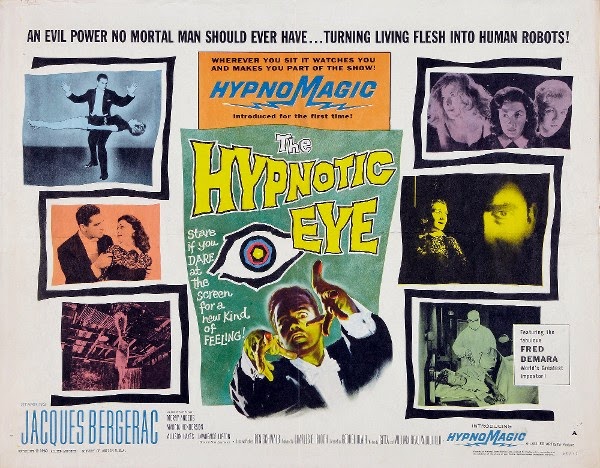
"The Hypnotic Eye" (1960) on Warner Archive Instant

"Will I be horrible? Will I be a monster? Will I?"


     Allison Hayes is a favorite here at the blog. Despite the fact that she didn't exactly star in masterpiece's of cinema, her very presence in a film all but guarantees it's going to be interesting. This is the case with the 1960 hypno-gimmick thriller, "The Hypnotic Eye", a  B-movie that has more going on than it's ballyhoo based pedigree might lead you to believe.

     The pre-credit sequence is an attention grabber that would make Sam Fuller proud. Through the unblinking steel gaze POV of a stove burner we witness the self immolation of a young woman's head. It's a real punch in the gut start to the picture and a sure-fire (no pun intended) way to get the audience's attention.

     Detective Dave Kennedy (Joe Patridge) is investigating a series of female self-mutilations, which currently number eleven. He questions the woman who torched her hair, now wrapped in bandages, who dies on the stretcher in front of him. This truly is a dark little picture.

     Despite the protestations of Doctor Phil (no relation, despite the moustache) Hecht (Guy Prescott) -a man who loves dart's, kimono's, pipe's and piano's, but hates hypnotist's- Dave goes to see a hypnotism stage show. Joining him are his girlfriend, Marcia (Marcia Henderson), and her friend, Dodie (Merry Anders). Desmond, the Gallic hypnotist, is played by Jacques Bergerac and Hayes is his leggy assistant, Justine. Female volunteer's are requested from the audience, and Dodie is selected and brought onstage. Using the power of hypnosis, but mostly the power of wires that are clearly visible in Warner Archive's sharp transfer, Desmond causes Dodie to levitate in the air.


     Returning home, Dodie decides to wash her face with sulfuric acid and that doesn't turn out well at all. As in the beginning, a POV shot is used, this time through the bottom of the sink. I wonder if a young Scott Spiegel saw this picture and was so impressed that he decided his own movies would be nothing but a series of inanimate object POV's.

     After visiting Dodie in the hospital, Marcia again attends Desmond's show, This time, she is called to the stage to be entranced. She closes her eyes in order to avoid being hypnotized, but manages to see the device of Desmond's power, the titular "hypnotic eye" with a blinking light that he holds in his hand. Thinking she's under his power, Desmond suggests to her that she visit him backstage at midnight. Marcia wants to investigate this weirdo so she goes to see him, tailed by Dave and Dr. Phil. Her journey down a dark alley at the witching hour has a Tourneur-esqe spookiness to it, aided by Marlin Skiles' shivering score.


     Arriving in the dressing room, Marcia accidentally becomes transfixed by the hypnotic eye. This may be a bit of a stretch, but the shot's of Marcia, a late 1950's beauty, illuminated by the eye's strobe effect, have an almost proto-Lynchian quality to them. Desmond uses his control over the young lass to do what any self respecting hypnotist perv would do: he takes her to a coffeehouse to see a poetry reading by James Lipton's dad, who apparently was a big deal beatnik.


      After returning to Marcia's home, Desmond's amorous advances are cut short when he is dismissed by his assistant. Justine, with her star shaped beauty mark, is revealed to be the true hidden Svengali of female self-harm. This should come as no surprise to those familiar with Hayes' oeuvre, as she frequently played powerful, in-control women. She attempts to have Marcia scald herself in the shower, but is stopped when Dave knocks on the door.


     Past victim's of these post hypnotic suggestions are questioned, and none of them recalls ever having been put under. Dave finds an official "The Hypnotic Eye" balloon in one of their purses and that gives him all the evidence he needs.

     A majority of the end of the picture is Desmond's stage show where he performs his tricks on the entire viewing audience. He stands on the stage, his reverb drenched voice giving orders. There is a silly surrealness to it all when this is combined with the comical reaction shot's of the audience acquiescing.


     There's a sadisticness to this picture. Whereas most film's of it's ilk glory in the shock of the moment of violence, this one is more concerned with what happens after, when the victim's have to exist with their future's reduced to a fraction. We see only two of the mutilation's occur, but we meet many of the scarred women living with the aftermath of their deformation. In these scenes there seems to be an empathy at work. It's in the scene of the woman dying on the stretcher, it's in the scene's of Dodie lying in her dark hospital room, it's in the scene of the lonely mother- her children having been taken from her- who's too ashamed to even answer the door. Whether or not it's intentional is unknown, but for a gimmick based B-movie it's something worth noting.


     Ostensibly a film that's a vehicle for old timey hypnosis trick's, "The Hypnotic Eye" has more going for it than just the free balloon audience member's got at the box office. Allison Hayes is perfect as the seductress of destruction; arch eyebrowed and fueled by vengeful jealousy, she is a figure of statuesque misogyny. It's a picture about the power of the psyche being harnessed to disfigure the flesh; as nastily interested in deformations of the female form as it is in hypnotism. And lastly, can somebody please make a prop replica of the actual hypnotic eye so I can buy one?